
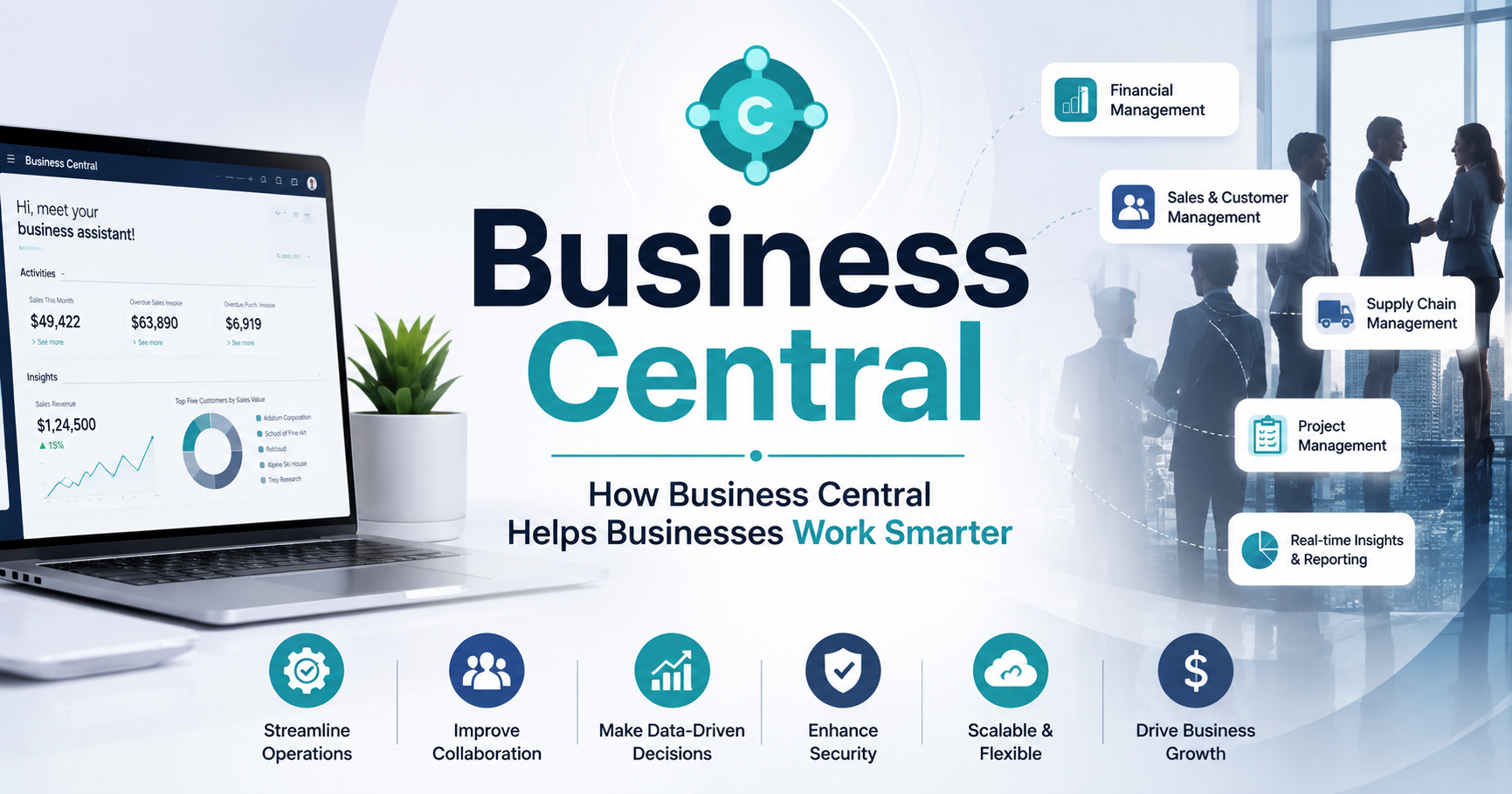
How Business Central Helps Businesses Work Smarter
In today’s competitive business environment, companies need more than basic accounting or inventory tools to stay efficient. They need a connected solution that helps teams manage finances, customers, operations, sales, and supply chains from one place. Business Central is designed to help small and mid-sized businesses simplify daily processes, improve decision-making, and work more efficiently.
As a Microsoft business management solution, Business Central brings essential business functions together in a single platform. By reducing manual work and providing real-time insights, it allows businesses to focus more on growth and less on administrative tasks.
What Is Business Central?
Business Central is a cloud-based enterprise resource planning (ERP) solution from Microsoft. It helps businesses manage core operations such as financial management, sales, purchasing, inventory, projects, and supply chain activities.
Instead of using separate systems for different departments, businesses can use Business Central to connect important processes. This creates a centralized flow of information and makes it easier for employees to access accurate data.
How Business Central Helps Businesses Work Smarter
1. Centralizes Business Data
One of the biggest advantages of Business Central is that it brings business information into one connected system. Finance, sales, purchasing, inventory, and other teams can work with the same data.
A centralized system reduces the need to maintain multiple spreadsheets and disconnected applications. Employees can find important information faster and collaborate more effectively.
2. Automates Repetitive Tasks
Manual data entry and repetitive administrative work can consume valuable time. Business Central helps automate many routine processes, including invoicing, financial reporting, purchasing workflows, and inventory management.
Automation can also reduce the risk of human errors. Employees can spend less time on repetitive tasks and more time on activities that contribute to business growth.
3. Improves Financial Management
Accurate financial information is essential for making smart business decisions. Business Central provides tools for managing budgets, accounts payable, accounts receivable, cash flow, and financial reporting.
With better visibility into financial performance, businesses can monitor expenses, understand profitability, and identify potential financial issues earlier.
4. Provides Real-Time Business Insights
Making decisions based on outdated information can create unnecessary risks. Business Central helps businesses access current operational and financial information.
Managers can use dashboards, reports, and analytics to understand business performance and identify trends. This supports faster and more informed decision-making.
5. Simplifies Inventory and Supply Chain Management
Inventory problems can lead to increased costs, delayed orders, or unhappy customers. Business Central helps businesses monitor inventory levels, manage purchasing, and track products throughout their operations.
Better inventory visibility can help companies maintain appropriate stock levels while avoiding unnecessary overstocking or shortages.
6. Supports Sales and Customer Management
Business Central also helps businesses manage sales processes and customer information. Teams can track orders, invoices, customer interactions, and sales performance from a connected system.
Having access to relevant customer and sales information helps employees respond faster and provide a more consistent customer experience.
7. Enables Business Growth
As a business grows, its processes and data requirements become more complex. Business Central provides a scalable platform that can support changing business needs.
Companies can also integrate Business Central with other Microsoft tools and third-party applications to create a more connected technology environment.
Why Choose Business Central?
Businesses choose Business Central because it combines essential ERP capabilities with automation, reporting, integration, and cloud accessibility. It can help organizations reduce operational complexity while giving employees the tools they need to work productively.
By connecting departments and improving access to information, Business Central can create a more efficient and collaborative workplace.
Frequently Asked Questions
What is Business Central used for?
Business Central is used to manage business operations such as finance, sales, purchasing, inventory, supply chain management, and projects through one integrated ERP platform.
Is Business Central suitable for small businesses?
Yes. Business Central is designed particularly for small and mid-sized businesses that need stronger financial and operational management without maintaining multiple disconnected systems.
How does Business Central improve productivity?
It improves productivity by connecting business data, automating repetitive processes, reducing manual entry, and giving employees faster access to important information.
Is Business Central cloud-based?
Yes. Business Central is available as a cloud-based solution, allowing authorized users to access business information and processes from supported devices and locations.
Can Business Central integrate with other Microsoft products?
Yes. Business Central can integrate with various Microsoft products and services, helping businesses create a connected digital workplace.
Conclusion
Working smarter means having the right information, processes, and tools available when they are needed. Business Central helps businesses achieve this by bringing financial and operational activities together, automating routine tasks, improving visibility, and supporting better decisions.
For growing businesses looking to simplify operations and build a more connected organization, Business Central can provide a strong foundation for improving efficiency and supporting long-term growth.